
What 10+ years as a dog trainer has taught me about dog training series
He does everything he’s supposed to inside and in the yard, but every time we go out for a walk, it’s like his brain went in the opposite direction. The dog doesn’t listen outside.
Every cool blade of grass or bird call in the distance gets more focus from him. He doesn’t listen outside at all.
Yet, this is completely normal behaviour, and all dog owners go through this. All dog owners. You’re not doing anything wrong, and you’re not alone.
It’s completely natural and healthy for dogs to want to explore their surroundings. Sniffing everything is how they learn about life around them. They collect information about who was in the area last, what type of wildlife lives there, etc. It satisfies their curiosity and tones down their excitement level.
So let’s dive into how we can work on getting some focus while also giving our dogs the space they need to explore safely.
Why Your Dog Doesn’t Listen Outside
Indoors, everything is familiar. He’s sniffed and interacted with everything inside the house a thousand times. It’s boring for him.
Therefore, when you take him to a new environment, naturally he’s going to get excited, which can literally cause his brain to shut off. Let’s dive into how a dog’s brain works for a second.
Your dog has two sides to his brain. The logic side and the reactive side. When your dog is over-aroused, either with extreme fear or extreme excitement, the reactive side takes over.
Don’t worry. Your dogs not dumb, and you’re not doing anything wrong; this is how your dog’s brain naturally works. It’s normal, and therefore why your dog won’t listen outside.
However, there is a way to work through this.
Dogs Don’t Generalize Like We Think
When I’m working with my dogs in new environments, I do several things to prepare. It’s very simple and easy to replicate in almost every environment.
- I allow my dog to explore the new area using a 30-foot lead.
- High-value rewards of any kind. New toy my dog loves, treats my dog loves but never gets, a stick, etc.
- Take a step back in your training.
Seems simple, doesn’t it?
Especially the stick part, everyone has a stick, right? For one of my dogs, it was egg cartons. I don’t question, I just smile and nod.
Let’s expand on these points for a minute, shall we?
The first point, use a 30-foot lead. This allows me to give my dog space to explore the environment safely before we get started. He can wander around and sniff everything out, satisfying his curiosity. I can walk around with him or drop the lead and retrieve it when he gets too far.
Some areas you have to keep them with you, so a regular leash works fine. Areas where space allows, you can use the long lead and either hold the end or drop it. Allow your dog five to ten minutes to sniff around. This will tone down his excitement level so the logical side of the brain turns back on.
Yes, we’re literally flipping a switch in your dog’s brain.
If you’re interested in a long lead you have a few options. You can use a rope with a snap at the end to connect to your dog’s collar. There’s also 30-foot leads you can purchase. This is the one I have and we love it.
Second and third points. Once your dog’s explored, reel him back in using the leash. Ask for something simple he knows how to do, but train him as if he’s never done it before in his life. The very first step to teaching sit, for example.
Re-train him using high-value rewards. Do a couple of repetitions, then tell him to go away. Allow him to go back to exploring. Give him 2-3 minutes and repeat. Every time you repeat this process, you’ll build on the exercise you’re working on.
After a while, your dog won’t want to go away from you and will want to keep working.
How does this work?
Reverse psychology. Yes, it works on dogs too!
The new environment is not as exciting as when you first started, but you’re very exciting because you bring the fun!
This is called proofing dog training.
You May Be Advancing Too Quickly in Training
A common mistake is advancing too quickly while proofing. This is something even experienced dog trainers struggle with sometimes. You think your dog has learned the behaviour well, so you move on to the next step.
If you move onto the next step too soon, however, it can cause your dog to revert backward. This is called dog training regression. It happens to everyone, and it won’t ruin your dog; I promise.
When you’re working in a new environment, your dog will show you the things he knows well, and the things that need more work.
Here are a few examples of what this looks like.
- Once your dog has explored and you’re ready to get to work, but he won’t do the behaviour even at step 1, there’s a chance he needs more practice at home.
- Your dog is exhibiting the behaviour in the new environment, but when you wean off the high-value rewards, he gets confused. He’ll start sniffing around, or he’ll lie down. Give him a break, then change the cue to something different. Build this behaviour up at home, then try again. Training in distractions sometimes goes well, and sometimes you have to go back.
- If your dog isn’t fluent with the behaviour at home, asking him to do it in a distracting environment is setting him up for failure. Make sure he’ll do it all over the house and on the first cue. Then work on it in distracting places.
Why Your Dog Ignores Treats Outside
Anyone else’s dog refuse treats when on a walk? I’m talking high, high value treats. Like, last night’s leftover steak cut up into tiny pieces, mixed with chopped beef liver, mixed with dog food. Maybe even tiny pieces of hot dog. I’m talking high, high, high value here. The stuff your dog never, ever gets.
You think your dog will jump over the moon for this cocktail of a treat bag.
However, she sticks her nose up when I try to give her one.
Ok, now what?
Remember when we discussed the two sides of your dog’s brain?
Your dog’s reactive side of the brain has taken over. She’s on high alert and may over-react at the slightest thing. However, it could be the other way, and she’s extremely excited, and the first person to get close enough is getting an overzealous greeting.
Take your time with her.
Stop walking and allow her to explore an area for a few minutes.
Use the environment as a reward wherever possible.
Ask for a behaviour you know she knows very well, and reward it with either a treat, if she’ll take it yet, or the environment.
What does this look like?
You get to the corner close to your house. It’s a corner with lots of grass but not someone’s lawn. There’s a fire hydrant there, and the community you live in put a huge planter there with pretty flowers.
Tell your dog, “go sniff.” Yes, put this on cue!
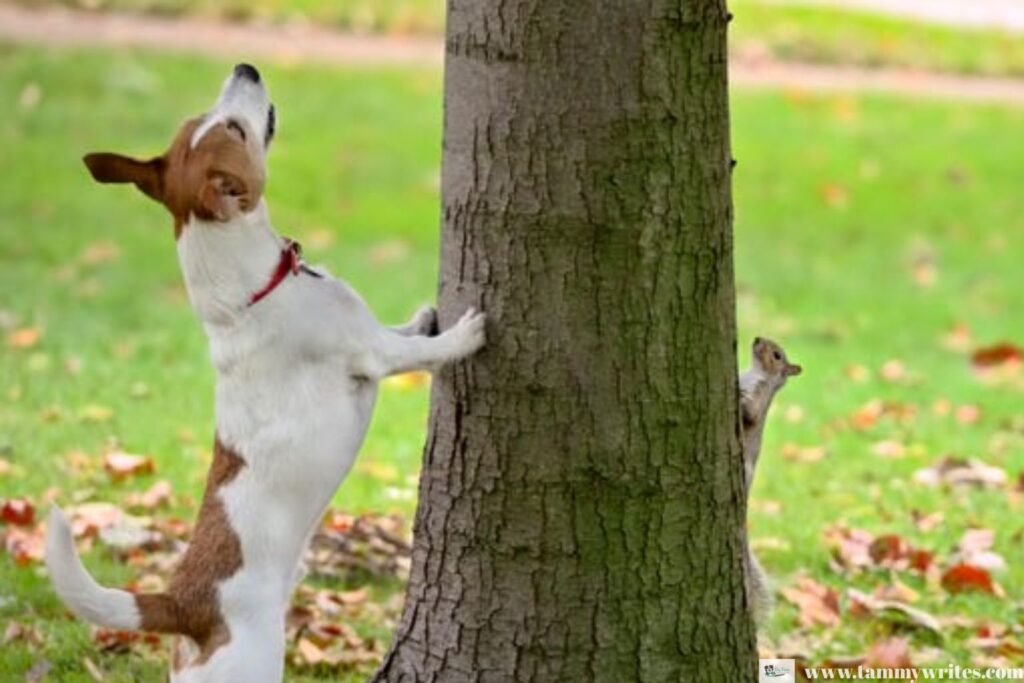
Give your dog several minutes to sniff around the area, listen to the birds calling in the distance, and watch a squirrel scurry up a tree. Take a moment to enjoy how pretty and calm the day feels.
Enjoy the moment with your dog. Walks don’t have to be just about walking. They can be just as impactful when you stop to smell the roses.
Actually, lots of these types of interactions can burn your dog’s energy faster than just walking.
After a few minutes, ask her for a sit. See if she’ll take a treat. Sometimes this is all that is needed to get your dog’s reactive side to calm down enough to flip her brain back on. She may do the cue, but still may not take the treat. That’s okay too. Tell her, good girl! Then continue with your walk.
When you walk again, make sure you’re not allowing your dog’s leash to tighten. Dogs will pull more when their brains are in overdrive. Therefore, even in this high state of arousal, make sure you’re stopping every time the leash gets tight, bring your dog back to position, continue on.
If your dog won’t come back to position, simply change the direction you’re walking. This teaches your dog that you’re the one leading the walk, and she needs to pay attention to your change of directions. The more you change direction when they pull, the less pulling she’ll do because she will have to focus on you to know where you’re going next.
The Fix Isn’t More Pressure — It’s Better Progression
Let’s recap.
There are two sides to your dog’s brain, and when the reactive side is in overdrive, it’s like their brain has stopped functioning. Such as when your dog ignores treats outside, or your dog won’t listen outside.
Slow down. When you slow down training, it allows your dog to explore. Enjoy exploring the world around you with your dog. Walks don’t need to be rushed.
Re-train everything. Once your dog’s calm in the new environment, retrain behaviour so they learn to generalise. The more times you re-train something, the stronger that behaviour is going to be. Don’t think of the process as taking too long; think of it as building a stronger bond. Proofing dog training is an important step in having a calm dog that will listen to you everywhere.
Most importantly, all dogs and dog owners go through this phase. You’re not alone. Even seasoned dog trainers struggle when training with distractions, or experience dog training regression. This isn’t something you did wrong, and you’re not ruining your dog.
You’re doing everything right, and now you have more information to help you over-come your current obstacles.
If you enjoyed this article, check out the other ones we have on our blog. You might find them just as helpful, and hopefully entertaining, as this one. As part of a series there’s:
Part 1: Mixed Signals In Dog Training.
Part 2: Motivation in Dog Training.
If you enjoyed this article, subscribe to my newsletter. You’ll get notified every time I post a new blog post. I post twice a month on all things related to pets. I hope this article helped you understand your dog a little better.